

The Missing Middle
A critical layer of India’s private capital stack remains underserved -- even as firms like Amicus Capital Partners demonstrate what disciplined mid-market investing can deliver.

This week, we look at India’s mid-market private equity through the lens of Amicus Capital Partners. We break down TPG’s $1 billion bet on TCS’ HyperVault in the AI Briefing. A quick rundown on billion dollars in fresh fund commitments across consumer, inception-stage, and AI-heavy strategies. And in Pursuits, we spotlight Bridlen, the Chennai shoemaker quietly shaping a new language of Indian craft and formal style.
Lede
The Amicus Capital Lens on Mid-Market PE in India
When Mahesh Parasuraman went out to raise his first fund back in 2015, he knew it would be tough but he didn’t anticipate falling short. Parasuraman and Amicus Capital Partners co-founder Sunil Theckath Vasudevan were shooting for a $125 million fund. They ended up raising $88 million. It drove them to a slower, more cautious pace of dealmaking. “If we didn’t do well in the first fund, there would be no second fund,” Parasuraman, earlier a managing director with The Carlyle Group, told me in the latest episode of Unscripted.
In June this year, Amicus raised $214 million for its second fund – this time exceeding its target. It’s come off the back of steady payoffs from the Fund I portfolio. Logistics platform Pickrr Technologies was acquired by Shiprocket in a $200 million deal in 2022 within a year of Amicus’ investment; last year, gig worker platform Awign, which Amicus backed in 2022, was acquired by Japanese firm Mynavi; and in October this year, it partially exited non banking financial company Berar Finance.
With the listing of portfolio company Aequs, Parasuraman says capital returned from Fund I should be at 70% by December, taking it closer to the goal of delivering a 1x DPI next quarter.
Amicus exited part of its stake in Aequs, a precision manufacturer of aerospace components, in a pre-IPO transaction and sold some more during the IPO this week. The three-year investment fetched a 4x return and the firm retains significant upside for its remaining stake. Aequs’ Rs 922 crore ($102 million) offering, priced at Rs 118-124 per share, closed yesterday on strong institutional and retail subscription.
As a mid-market focused private equity (PE) firm in India, Amicus inhabits a territory that comes with its opportunities and challenges. There are still relatively few firms that meaningfully serve the sizeable chunk of companies that need help getting from Rs 100-200 crore revenues to Rs 1,000-2,000 crore. Success in this segment usually calls for deep operational support alongside patient capital.
While that scenario spells opportunities for firms such as Amicus, institutional capital for mid-market PE has historically been less freely available than for venture capital and later stage PE. Domestic capital (family offices, insurers and quasi sovereign pools like NIIF) is beginning to show up for mid-market fund managers but the segment remains structurally underserved.
That isn’t just a mid-market problem. It’s the bridge that makes the entire capital stack work.
AI Briefing
TPG’s Bet on India as the Engine Room of AI
Late last month, private equity firm TPG committed to investing $1 billion in IT services and consulting company TCS’ HyperVault project, which aims to build gigawatt scale AI data centers in the country. TPG is expected to own between 27.5% and 49% of the TCS subsidiary.
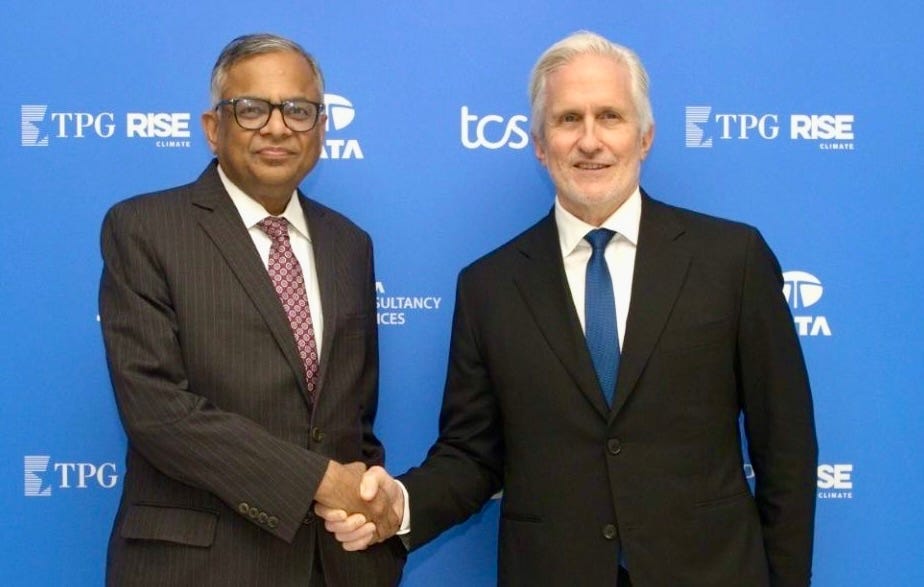
The $2 billion project signals a clean break from the “digital landlord” era. Traditional data centers operated like real estate: renting space and electricity for static workloads such as web and mobile apps.
HyperVault flips that model. It treats compute as a utility for AI companies and hyperscalers, converting power directly into intelligence that learns and evolves.
That’s why TPG is backing gigawatt-scale capacity (enough to power 750,000 homes) with a focus on liquid cooling, which is critical to negate the heat generated by the high-density hardware, such as GPUs used to train and run AI in such facilities.
This shift is also redefining location strategy.
Mumbai still holds more than half of India’s data center capacity and remains a crucial hub thanks to strong connectivity and submarine cables. But AI compute demands more than proximity to enterprises — it requires large power corridors, renewable supply, and room to scale. That’s where Visakhapatnam is gaining momentum. Google (with the Adani Group) and Reliance (with Brookfield Corporation and US-based Digital Realty) are both planning multi-gigawatt campuses there, positioning the city as a possible “Singapore of AI compute.” Visakhapatnam offers what dense metros struggle to scale: abundant land, direct port access, affordable labor, and proximity to emerging green energy zones.
The broader bet is clear: India wants to move from the world’s back office to the engine room of AI.
But that path will demand facing AI’s environmental cost — its high energy demand and resulting emissions, heavy water usage for liquid cooling, and rapid buildup of electronic waste from manufacturing and disposing of AI hardware. If these challenges are met head-on, AI compute could power domestic transformation as well as emerge as one of India’s most valuable exports.
Shubham Sharma is an independent journalist who specialises in writing about AI and data. He has written for leading publications including VentureBeat, Mint, TechCircle and VCCircle. He also co-hosts The Bottom Line podcast.
Capital Flows
New Funds, New Signals
If the mid-market feels underserved, the early stage end of the spectrum is moving in the opposite direction. AI-first funds, consumer specialists, and cross-border managers are deepening their pools, signalling continued confidence in India’s innovation economy.
Nexus Venture Partners has raised one of the year’s largest cross-border early stage funds, doubling down on AI, enterprise software, consumer and fintech. The $700 million Fund VIII will back startups at the seed and Series A stages in the US and India.
Haptik co-founder Aakrit Vaish and former Together Fund principal Pratyush Choudhury have launched Activate, a $75 million venture capital fund, to back AI founders “from Day Zero,” writing $500,000–$3 million cheques. Limited partners include venture capitalists Vinod Khosla and Shailendra Singh, Perplexity founder Aravind Srinivas, and General Catalyst.
Fireside Ventures has raised its largest consumer fund yet at $253 million. The fund, according to reports, has a 50:50 domestic and global limited partner split — a shift from a heavier reliance on domestic capital in earlier funds. Limited partners include Abu Dhabi Investment Authority, Investment Corporation of Dubai (ICD), HarbourVest, Fidelity International, Sharp Ventures and Mirabilis. The raise reinforces the firm’s conviction in India’s consumer thesis at a time when discretionary spending is somewhat uneven.
Recco | Notes on Culture, Craft, and the Considered Life
Bridlen’s Quiet Ascent

Chennai-based Bridlen has, over the past decade, emerged as one of the few Indian labels operating seriously in the formal shoe space.
The brand was founded by Hasan M.K., who spent more than three decades working with Japanese shoemaker Jose Maria Watanabe, initially producing Goodyear-welted footwear for the Japanese market before developing Bridlen into a consumer-facing brand in the mid-2010s.
Today, Bridlen produces more than 10,000 pairs a year, drawing on French and English leathers and traditional construction. Its Founders 25 line uses oak-bark leather from J. & F.J. Baker, one of England’s last heritage tanneries, while other styles use hides from Charles F. Stead in England and Mastrotto in Italy. Lining leathers are sourced from Leather Working Group–certified tanneries in India.
Most materials are imported simply because the grade of leather the brand works with is not yet produced domestically. The aesthetic, internally described as a British–Japanese mix, favours clean proportions and longevity over flourish. While Japan and Europe remain strong markets, domestic demand over the past four years has grown meaningfully.
In India, Bridlen’s customers include CXOs, bankers, lawyers, founders, and men who also buy from makers such British heritage brands such as John Lobb.
Bridlen recently opened Labo, an appointment-led atelier in Chennai for fittings and small-batch work, and will follow it with a Mumbai store this month. Prices are up to Rs 60,000.
Thank you for reading The Runway. We’d love to get your feedback. Drop us a line and stay tuned for the next edition.